
However you feel about Emerald Fennell’s adaptation of Wuthering Heights, there is no denying that this classic novel is in the minds and on the lips of almost everyone right now. If your curiosity is piqued and you’d like to explore the text or its themes further, we have what you need at the Consortium Library!
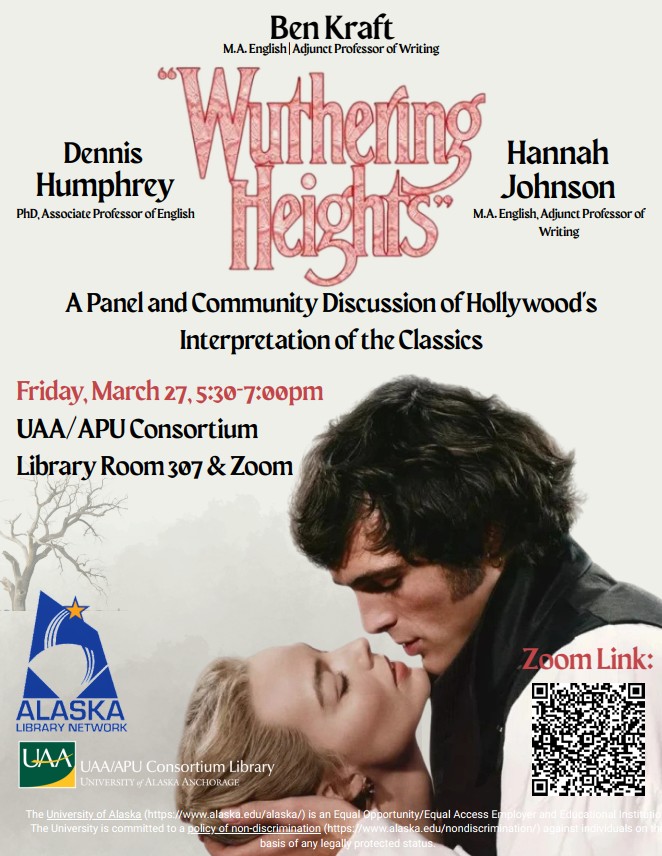
We will be hosting a panel and community discussion featuring faculty from the UAA English Department both in person in Library Room 307 and on Zoom – check out the flyer below and scroll down to explore resources on your own.
Want to go back to where it all began and get your hands on the source text? There are several print copies available through the catalog. Browse copies and find an available one here (and remember that you can request a book from another library by clicking “place hold”).
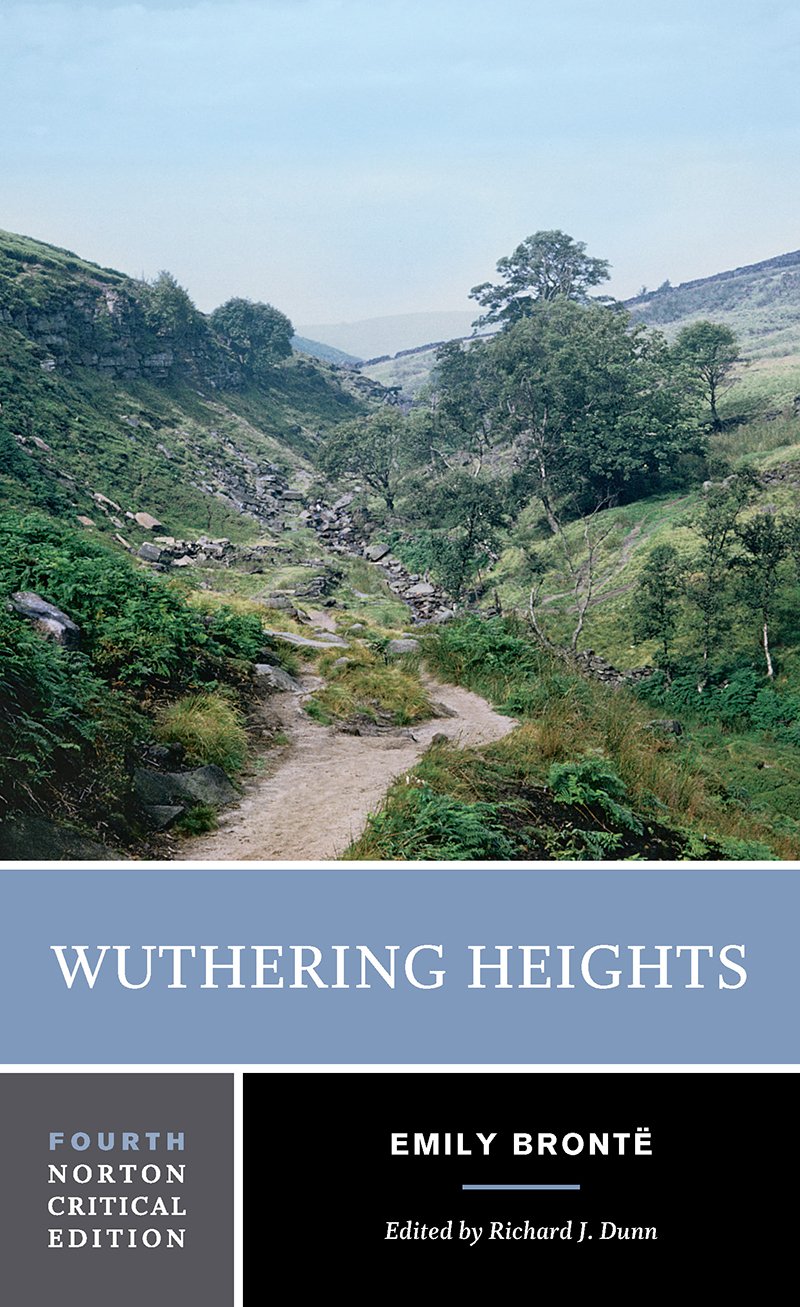
This particular copy includes historical context, background on the Brontë sisters, contemporary reviews from 1847 and 1850, and modern criticism.
Wuthering Heights is now part of the public domain, so you can also download an eBook copy to read on your phone, computer, or eReader from Project Gutenberg.
Let’s dive deeper!
Twentieth century interpretations of Wuthering Heights : a collection of critical essays, edited by Thomas Vogler, explores various aspects of the text. Through these essays, you’ll read several different viewpoints that dive into the structure of the novel, its major themes, and offer perspectives on the work as whole.
Wuthering Heights: the writing in the margin by Maggie Berg can serve as a reading companion and will guide you through some of the historical context and main characters and themes. This would be helpful for both first-time readers and re-readers.
Romantic vision and the novel by Jay Clayton explores the role of the romantic visionary moment (a moment of transcendence) in the narrative structures of English novels. The author dives into a different text in each chapter – chapter 4 is devoted to Catherine and Heathcliff’s relationship (and expression thereof) in Wuthering Heights. He also studies Mansfield Park, Clarissa, and Little Dorritt, among others.
You can also read this thesis by a UAA Masters Student from 1997: The text of subversion: mythic disruption in Emily Brontë’s Wuthering Heights by Sheri Denison. The thesis explores mythical interpretations of the world created by the text and argues that it “emerges as a counter-cultural, subversive narrative, a narrative seeking the origins of chaos as well as civilization, and the origins of individual identity as well as social identity.”
Charlotte and Emily Bronte by Tom Winnifrith and Edward Chitham is a short text that gives an overview of the lives of the most well known of the Brontes. The complete poems of Emily Jane Brontë presents 200 of Bronte’s poems in one place. The volume was compiled posthumously by C. W. Hatfield.
Find other texts about Emily Brontë here and about Wuthering Heights specifically here.
Heathcliff’s character has always inspired debate and conversation – it’s no wonder that the film’s casting and portrayal of him would do the same. The articles and books below explore aspects of Heathcliff’s character, including his motivations and racialization. (Be sure to be logged in for off-campus access or connected to campus WiFi before clicking links)
- Emily Brontë’s Heathcliff: His Journey of Jealousy by Kitty Carlisle
- Heathcliff’s Abject State in Emily Brontë’s Wuthering Heights by Jennifer Lodine-Chaffey
- Shadows and sparks in Wuthering Heights by Maria Panagiotopoulou
- Heathcliff as bog creature: racialized ecologies in Wuthering Heights by Emma Soberano
- Geometries of race, class, and gender : identity crossing in Wuthering Heights by Carine M. Mardorossian (available at UAF, place hold to request!)
- From Simianized Irish to Oriental Despots: Heathcliff, Rochester and Racial Difference by Elsie Michie
- Myths of Power. A Marxist Study of the Brontës by Terry Eagleton
The relationship between Cathy and Heathcliff has drawn discussion since the publishing of the text. Is this the greatest love story ever told? How else might we interpret their relationship? These themes are explored in the following articles (and you can find many more beyond these!)
- The Two Faces of Love in Wuthering Heights by James Phillips
- An Appraisal of Catherine and Heathcliff’s Love Relationship by Graeme Tytler
- The lunatic and the devil’s disciple: the ‘lovers’ in ‘Wuthering Heights’ by Marianne Thormahlen
- Catherine Earnshaw’s journey to her home among the dead: fresh thoughts on ‘Wuthering Heights’ and ‘Epipsychidion.’ by Patsy Stoneman
A couple other articles I thought looked interesting are included below:
- Catherine Earnshaw’s Ghost Story: Wuthering Heights as Narrative of Female Revenge by Negeen N. Nikravesh
- Weeping and Wailing in Wuthering Heights by Graeme Tytler
Want to watch other adaptations of Wuthering Heights? There are several! These films are available on DVD through the library system – you may have to place a hold on some of them:
- Wuthering Heights (2011)
- Wuthering Heights, PBS Masterpiece Classic (2009)
- Wuthering Heights (2003)
- Wuthering Heights, BBC Mini-Series (1967)
- Wuthering Heights (1939)
If you’re interested in learning more about Wuthering Heights, or any other topic, get in touch with us at the Information and Research Help Desk – we’re always happy to help!